2026-03-23
Content
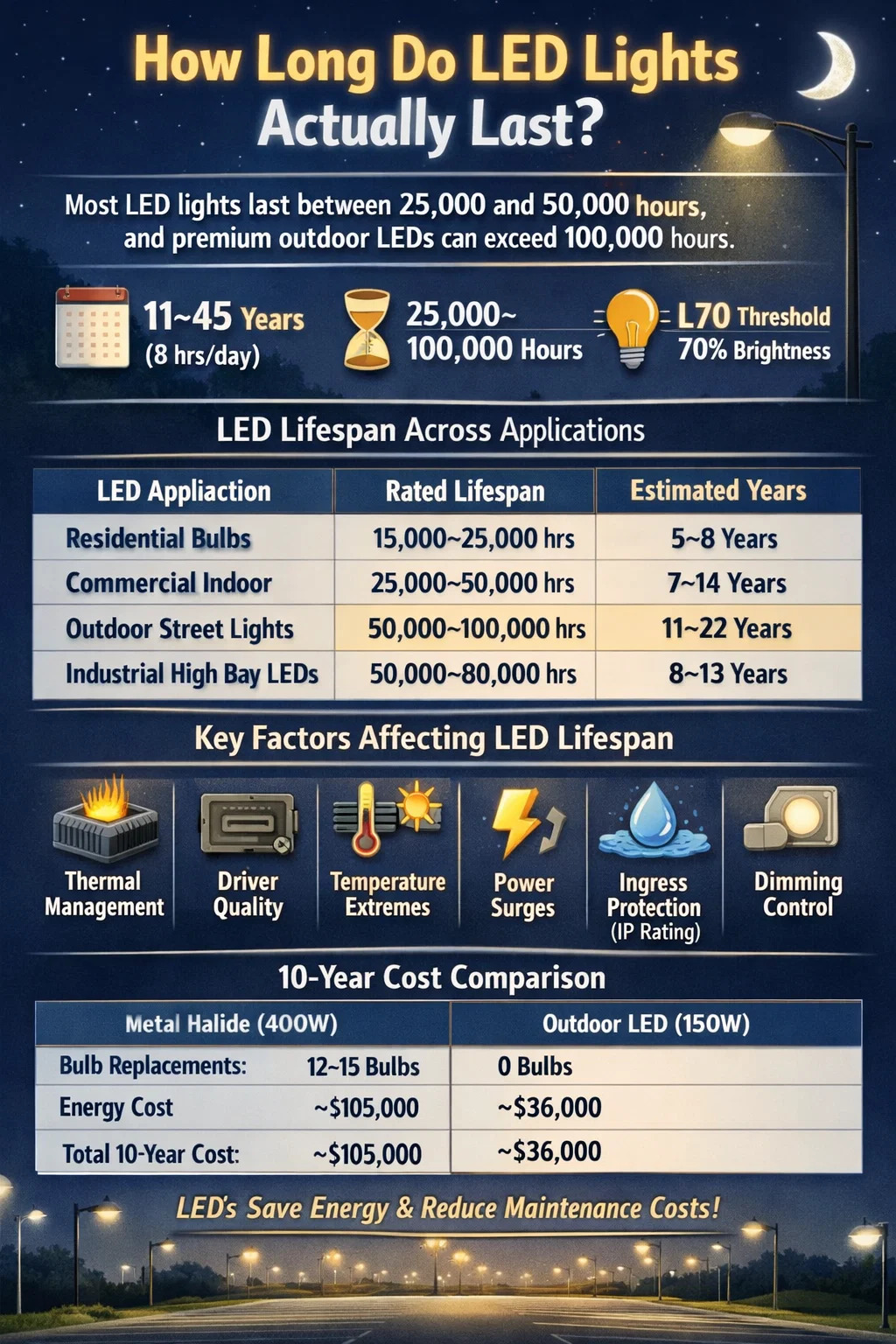
The short answer: most LED lights last between 25,000 and 50,000 hours, and premium-grade outdoor LED lighting products often exceed that range, reaching up to 100,000 hours under optimal conditions. That translates to roughly 11 to 45 years of real-world use if you run them for an average of 8 hours per day. Compare that to traditional incandescent bulbs, which burn out after just 1,000 hours, or fluorescent tubes that give you around 10,000 hours — and the performance gap becomes hard to ignore.
It's important to understand that LED "lifespan" doesn't mean the light suddenly goes dark after hitting a certain hour count. Instead, manufacturers define LED end-of-life at the point when the fixture's light output drops to 70% of its original lumen output — a threshold called L70. At that point, the light is noticeably dimmer, even if it's still technically functional. Some premium systems use the L80 or even L90 standard, meaning they maintain 80% or 90% of original brightness over the rated lifespan, which is a higher bar of quality.
These aren't just marketing numbers. They're measured through standardized testing procedures, particularly the IES LM-80 test (which measures LED component lumen maintenance) and IES TM-21 (which projects long-term performance based on test data). Any reputable outdoor LED lighting manufacturer should be able to provide these figures on request.
LED lifespan varies depending on the application category. Residential indoor LEDs tend to sit at the lower end of the range, while industrial and outdoor LED lighting is engineered for extended performance under harsh conditions. Here's a realistic comparison across different LED types:
| LED Application | Typical Rated Lifespan | Daily Use (8 hrs) | Estimated Years |
|---|---|---|---|
| Residential bulbs | 15,000–25,000 hrs | 8 hrs/day | 5–8 years |
| Commercial indoor fixtures | 25,000–50,000 hrs | 10 hrs/day | 7–14 years |
| Outdoor LED street lights | 50,000–100,000 hrs | 12 hrs/day | 11–22 years |
| Industrial high bay LEDs | 50,000–80,000 hrs | 16 hrs/day | 8–13 years |
| LED flood lights (outdoor) | 30,000–60,000 hrs | 10 hrs/day | 8–16 years |
One important nuance here: outdoor LED lighting is frequently designed to a higher engineering standard than its indoor counterpart, because it faces temperature swings, moisture, UV radiation, and physical stress from wind or debris. A quality outdoor fixture with an IP65 or IP66 rating and robust thermal management can often outlast a comparable indoor product by several years, even under heavier daily operating hours.
The rated lifespan printed on a spec sheet is a projection based on controlled lab conditions — it's a useful benchmark, but real-world results depend heavily on how the fixture is designed, installed, and operated. These are the factors that actually drive longevity in practice:
Heat is the single biggest enemy of LED longevity. LED chips themselves generate very little heat through the light emitting process — unlike incandescent bulbs which radiate most of their energy as heat from the filament. However, the driver and electronics in the fixture do generate heat, and that heat must be efficiently dissipated away from the LED junction. When junction temperature climbs above the design threshold (typically above 85°C for most commercial LED chips), lumen depreciation accelerates dramatically. A poorly designed fixture with inadequate heat sinking can cut rated lifespan by 40–60%. This is why high-quality outdoor LED lighting products invest heavily in aluminum housing, heat sink fins, and internal thermal design — it's not just aesthetic.
The LED driver — essentially the power supply that converts AC mains voltage to the DC current that LEDs need — is often the first component to fail in an LED system. A high-quality driver from brands like Meanwell, Inventronics, or Philips Advance can itself be rated to 50,000+ hours. Budget drivers, on the other hand, often fail within 10,000–20,000 hours. This means that a fixture with a premium LED chip array but a poor driver will underperform its potential significantly. When evaluating outdoor LED lighting, always ask specifically about the driver brand and its rated hours — it's a reliable indicator of overall build quality.
This is particularly relevant for outdoor LED lighting installations. LEDs actually perform better in cold environments — a fixture rated for 50,000 hours in a temperate climate might perform even longer in a cold northern climate, because lower ambient temperatures reduce thermal stress on the components. Conversely, installations in hot climates — such as rooftop flood lighting in desert regions or street lights in tropical cities — face additional thermal load. In these environments, oversizing the fixture (using a higher-wattage model run at partial capacity) or selecting fixtures with active cooling systems can compensate and maintain rated lifespan.
Voltage spikes, surges, and fluctuations are common in outdoor electrical installations — especially in commercial zones or industrial areas with heavy machinery nearby. These events stress the driver and can shorten LED lifespan considerably. Quality outdoor fixtures include surge protection, typically rated to 10kV or higher per IEC 61000-4-5 standards. Fixtures without this protection are more vulnerable in outdoor environments where lightning strikes and grid disturbances are a real concern.
Moisture infiltration is one of the primary causes of premature failure in outdoor LED lighting. The IP rating system (defined by IEC 60529) describes how well a fixture is sealed against dust and water. For most outdoor applications, a minimum of IP65 is recommended — this means the fixture is fully dust-tight and protected against water jets from any direction. For harsher environments like marine locations, car washes, or areas with heavy rainfall, IP66 or IP67 is preferable. A fixture running in a damp environment without adequate sealing will corrode internally and fail years before its rated lifespan.
Counterintuitively, dimming LEDs can extend their lifespan rather than shorten it. Running LEDs at 80% of rated current reduces thermal stress and slows lumen depreciation. Many smart outdoor LED lighting systems incorporate adaptive dimming — reducing output during low-traffic nighttime hours — which simultaneously cuts energy consumption and extends fixture life. However, only use dimming systems that are explicitly compatible with your driver. Mismatched dimming systems can cause flicker, premature driver failure, and accelerated LED degradation.
The lifespan advantage of LED becomes most convincing when you translate it into maintenance costs and total cost of ownership over a 10-year period. Consider a parking lot installation with 50 light poles, running 12 hours per night:
| Metric | Metal Halide (400W) | Outdoor LED (150W) |
|---|---|---|
| Rated Lifespan | 15,000 hrs | 50,000 hrs |
| Bulb replacements (10 yrs) | ~3 replacements | 0 replacements |
| Annual energy cost (50 units) | ~$8,760 | ~$3,285 |
| 10-year maintenance labor cost | $12,000–$18,000 | $1,000–$2,000 |
| Total 10-year operating cost | ~$105,000 | ~$36,000 |
These figures are illustrative but reflect real-world project economics consistently seen in commercial outdoor LED lighting upgrades. The savings are driven primarily by two factors: dramatically reduced energy consumption (LED typically delivers the same or better illumination at one-third to one-half the wattage) and near-elimination of lamp replacement labor costs, which require bucket trucks, certified electricians, and traffic control in many outdoor settings.
Outdoor LED lighting faces a fundamentally different set of engineering challenges than indoor fixtures. The design decisions that go into a high-quality outdoor fixture directly determine whether it hits its rated lifespan or falls short. Here's what separates long-lasting outdoor LED products from mediocre ones:
These design elements are most visible in product categories like LED street lights, area lights, parking lot fixtures, sports lighting, and architectural floodlights — segments where the cost of premature failure is high, both in terms of replacement cost and disruption to operations.
Because LEDs degrade gradually rather than failing suddenly, it can be difficult to recognize when a fixture has reached end-of-life. These are the most reliable indicators:
For commercial outdoor LED lighting installations, implementing a scheduled photometric survey every 5 years allows facility managers to track actual lumen depreciation against the fixture's rated L70 curve and plan replacements proactively rather than reactively.
Getting the most out of LED investment requires attention at three stages: selection, installation, and maintenance. Cutting corners at any of these stages can shorten fixture life significantly.
Not all LED chips are created equal. The semiconductor technology behind an LED module determines not only efficiency and color quality but also long-term stability. The major chip manufacturers — including Cree, Lumileds, Osram (now ams-Osram), Nichia, and Samsung — publish detailed lumen maintenance data for their chips that responsible fixture manufacturers use to support their lifespan claims.
Several chip technology developments have directly extended LED lifespan in recent years:
For buyers of outdoor LED lighting, the practical takeaway is that products using well-documented, name-brand LED chips with published LM-80 data are a significantly safer bet than those using unspecified or proprietary chips with no independent performance validation.
No. LEDs degrade gradually rather than burning out suddenly. The most common failure modes are lumen depreciation (the light gets progressively dimmer) or driver failure (which causes flickering or sudden outage). The sudden "light out" failure characteristic of incandescent bulbs is much less common with LEDs, though driver failures can produce that effect.
Unlike fluorescent tubes, LEDs are not significantly harmed by frequent switching cycles. LEDs have no warm-up period and no filament to stress during ignition, so turning them on and off has minimal impact on rated lifespan. This makes them well-suited for use with motion sensors and occupancy controls in outdoor LED lighting applications — a combination that saves energy without sacrificing longevity.
In many commercial outdoor LED lighting fixtures, the driver is a modular component that can be replaced independently, which is cost-effective since drivers often fail before the LED array. LED module replacement is less common but available in some fixture designs. This repairability is increasingly valued in large-scale outdoor installations where the hardware cost of full fixture replacement is substantial. When evaluating fixtures, it's worth asking the manufacturer whether spare drivers and modules are available and for how long.
Yes — continuous operation accumulates hours faster, so a fixture will reach its L70 threshold sooner in calendar time. However, the rate of degradation per hour of operation doesn't change. A fixture rated for 50,000 hours will last roughly 5.7 years at 24/7 operation versus 17 years at 8 hours per day. In applications requiring 24-hour coverage, it's standard practice to specify fixtures with higher rated lifespans to maintain reasonable maintenance intervals.
Higher wattage means more heat generation, which does increase thermal stress if the thermal design isn't scaled appropriately. However, reputable outdoor LED lighting manufacturers design their thermal systems to match the wattage of the fixture. A well-designed 400W LED flood light should have a correspondingly larger heat sink and driver capacity than a 100W model. The lifespan risk comes when a fixture's thermal system is undersized relative to its wattage — which is more commonly a quality control issue than an inherent feature of higher-wattage products.

Contact Us for More Details
Contact Information
Add:
No. 8 Qingcang Road, Qiangjiao Town, 315612 Ninghai, Ningbo, China
Phone:
+86-574-83530320
Fax:
+86-574-83530330
E-mail:
Join our community and stay connected
 Custom Outdoor lighting Manufacturers

 English
 Français
 Español