2026-03-16
Content
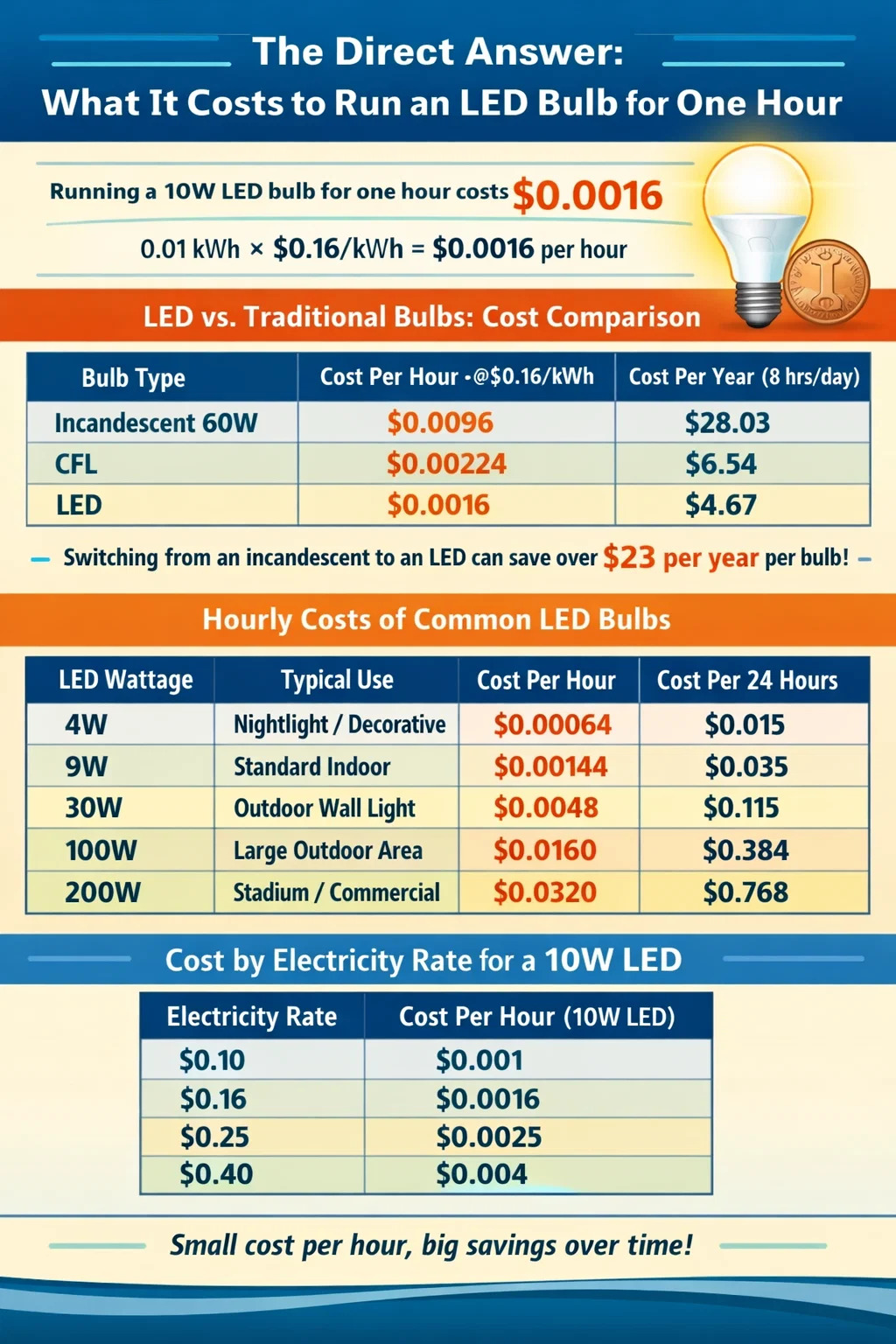
Running a standard LED light bulb for one hour costs roughly $0.001 to $0.002 — that's less than a fraction of a penny. To put a precise number on it: a typical 10-watt LED bulb, used for one hour, consumes 0.01 kWh of electricity. At the U.S. average electricity rate of approximately $0.16 per kWh (as of 2024), that comes out to about $0.0016 per hour.
That number sounds almost too small to matter — but when you scale it across dozens of bulbs, thousands of hours per year, and especially across outdoor LED lighting installations covering large areas, the numbers grow significantly. Understanding the per-hour cost is the foundation for making smart decisions about residential, commercial, and outdoor lighting.
The formula is simple:
Cost per hour = (Wattage ÷ 1,000) × Electricity Rate ($/kWh)
For a 10W LED at $0.16/kWh: (10 ÷ 1,000) × 0.16 = $0.0016 per hour.
To truly appreciate how cheap LED lighting is to operate, you need to compare it against what came before. A traditional incandescent bulb that produces the same brightness as a 10W LED typically draws 60 watts. A CFL (compact fluorescent) alternative sits around 14–15 watts for equivalent output.
| Bulb Type | Wattage | Cost Per Hour (@$0.16/kWh) | Cost Per Year (8 hrs/day) |
|---|---|---|---|
| Incandescent | 60W | $0.0096 | $28.03 |
| CFL | 14W | $0.00224 | $6.54 |
| LED | 10W | $0.0016 | $4.67 |
That's a $23.36 annual saving per bulb compared to incandescent, just from electricity. Now imagine a commercial property with 100 outdoor fixtures making that switch — that's over $2,300 saved every year, before factoring in bulb replacement costs.
LED bulbs come in a wide range of wattages depending on their intended use — from small 4W decorative bulbs to powerful 100W+ outdoor flood lights. Here's how hourly cost scales across the most common options at the U.S. average rate of $0.16/kWh:
| LED Wattage | Typical Use | kWh per Hour | Cost Per Hour | Cost Per 24 Hours |
|---|---|---|---|---|
| 4W | Nightlight / decorative | 0.004 | $0.00064 | $0.015 |
| 9W | Standard indoor bulb | 0.009 | $0.00144 | $0.035 |
| 15W | Bright indoor / small outdoor | 0.015 | $0.0024 | $0.058 |
| 30W | Outdoor wall light / pathway | 0.030 | $0.0048 | $0.115 |
| 50W | Outdoor flood light | 0.050 | $0.0080 | $0.192 |
| 100W | Large outdoor area / security | 0.100 | $0.0160 | $0.384 |
| 200W | Stadium / commercial outdoor | 0.200 | $0.0320 | $0.768 |
Even a large 200W outdoor LED — the kind used in commercial parking lots or sports fields — only costs $0.032 per hour. Compare that to the equivalent metal halide fixture that might draw 400–500 watts for the same output level, and the savings become undeniable.
The $0.16/kWh figure used above is the U.S. residential average, but electricity rates differ significantly from state to state and country to country. If you're in Hawaii, you might be paying over $0.40/kWh. In Louisiana or Oklahoma, you might pay as little as $0.10/kWh. In parts of Europe, rates can exceed $0.35/kWh.
Here's how hourly costs for a standard 10W LED shift based on electricity rate:
| Electricity Rate ($/kWh) | Cost Per Hour (10W LED) | Annual Cost (8 hrs/day) |
|---|---|---|
| $0.10 | $0.001 | $2.92 |
| $0.16 | $0.0016 | $4.67 |
| $0.25 | $0.0025 | $7.30 |
| $0.40 | $0.004 | $11.68 |
To find your exact cost, check your electricity bill for the rate in cents or dollars per kWh, then plug it into the formula. The difference between low-rate and high-rate regions can make LED outdoor lighting upgrades even more financially compelling in expensive electricity markets.
For homeowners, a single porch light isn't a budget concern. But outdoor LED lighting for commercial properties, municipalities, parking structures, and industrial facilities represents a major operating line item. Understanding per-hour costs is the first step toward modeling total cost of ownership for larger installations.
A typical home might have the following outdoor LED fixtures running from dusk to dawn — roughly 10–12 hours per night:
Total: 110W running 11 hours = 1.21 kWh per night = roughly $0.19 per night, or about $70 per year for the entire outdoor lighting setup.
A mid-size commercial parking lot with 20 LED pole lights at 150W each running 12 hours per night:
If the same lot previously used 400W metal halide fixtures, annual costs would have been closer to $5,606 — a savings of over $3,500 per year just by switching to outdoor LED lighting. Over a 10-year period, that's more than $35,000 saved, not counting reduced maintenance.
Not all outdoor LED lighting is the same. Different fixture types are built for different purposes, and their wattage — and therefore per-hour operating cost — varies considerably. Here's a practical overview:
Municipal LED street lights typically range from 40W to 200W. A 60W LED street light running overnight (12 hours) costs about $0.115 per night at $0.16/kWh. Across a city with 10,000 street lights, switching from 150W HPS (high pressure sodium) to 60W LED saves roughly $1.09 million per year in electricity alone.
Outdoor LED flood lights for security and architectural lighting typically run between 20W and 300W. A popular 50W LED flood light used as a driveway security light costs $0.008/hour and about $0.096 per 12-hour night. Motion-activated versions cut effective usage to perhaps 30–60 minutes per night, bringing annual costs down to just a few dollars.
Wall pack lights used on building exteriors, warehouse loading docks, and commercial facades generally range from 20W to 80W. A 40W LED wall pack running 12 hours nightly costs approximately $28 per year. Compare that to a legacy 175W metal halide wall pack at the same hours: roughly $122 per year.
These decorative and safety-focused fixtures are among the lowest draw in outdoor LED lighting, typically running 2W to 8W each. A set of 10 landscape pathway lights at 5W each, running 8 hours per night, costs less than $24 per year total. Solar-powered versions bring that cost to essentially zero.
Pole-mounted parking area lights range from 80W to 480W depending on pole height and coverage area. A 150W LED shoebox fixture on a 20-foot pole costs $0.024/hour. Running 12 hours nightly, that's $0.288/night or about $105/year per fixture.
High-mast outdoor LED lighting for sports fields and stadiums involves fixtures from 500W to 1,500W. A community soccer field with eight 500W LED fixtures running 4 hours per evening costs roughly $2.56 per evening or around $470 per year for 183 nights of use. The same field using old 1,000W metal halide lights would cost closer to $940/year.
The base formula is straightforward, but the real operating cost of outdoor LED lighting is shaped by several additional variables. Understanding each one helps you model costs more accurately and find further opportunities to reduce spending.
LED fixtures are highly compatible with dimming controls. A 100W outdoor LED dimmed to 50% draws approximately 50–55W, not exactly half due to driver inefficiencies, but close. Many cities now implement "adaptive street lighting" that dims to 30–50% during low-traffic late-night hours, reducing energy consumption by 40–60% during those periods. A fixture that would otherwise cost $60/year at full operation might cost only $30–40/year with smart dimming schedules.
Motion-activated outdoor LED lighting is one of the most effective cost-reduction tools available. A 50W security flood light that would otherwise run all night (12 hours) at a cost of $0.096/night might only trigger for a total of 1 hour per night with a motion sensor, bringing daily cost down to $0.008 — a 92% reduction in operating cost for that fixture.
The LED driver (the component that converts AC power to the DC the LED chip uses) has its own efficiency rating, typically 85–95%. A fixture labeled "50W" might actually draw 52–55W from the wall. For precision budgeting in commercial outdoor LED lighting projects, always use the fixture's measured input wattage rather than the rated LED wattage.
Outdoor LED lighting operates in extreme temperatures. While LEDs are generally more cold-tolerant than fluorescent lights, very high ambient temperatures can slightly reduce efficiency and increase lumen depreciation over time. In climates with extended summers above 95°F, heat management becomes a factor in both performance and long-term running cost calculations.
Commercial electricity customers may be billed on both consumption (kWh) and demand (kW peak). LED outdoor lighting systems with a high power factor (above 0.9) are more grid-friendly and can reduce demand charges. Lower-quality LED drivers may have power factors of 0.6–0.7, which increases apparent power draw and can affect billing for larger installations.
Per-hour electricity cost is just one component of what outdoor LED lighting actually costs over its lifetime. A complete picture includes purchase price, installation, maintenance, and eventual replacement. When you run the full numbers, LEDs win by a wider margin than the hourly electricity figure alone suggests.
A quality outdoor LED fixture is rated for 50,000 to 100,000 hours of operation. Running 12 hours per night, a 50,000-hour fixture lasts approximately 11.4 years before needing replacement. A comparable HPS street light might last 15,000–24,000 hours — requiring replacement every 3–5 years. Over the same 11-year period, you'd replace the HPS fixture 2–3 times, each time incurring both material and labor costs.
For outdoor commercial LED lighting at height — parking lot poles, street lights, warehouse exteriors — maintenance requires bucket trucks or lift equipment. Each service visit for a single fixture can cost $150 to $400+ in labor, independent of parts. Cutting replacement frequency from every 3 years to every 10+ years by switching to LED can save thousands in maintenance labor per fixture over the fixture's life.
| Cost Category | 150W HPS Fixture | 60W LED Fixture |
|---|---|---|
| Initial fixture cost | $120 | $180 |
| 10-year electricity cost | $1,051 | $420 |
| Bulb replacements (×2) | $60 | $0 |
| Maintenance labor | $600 | $150 |
| Total 10-Year Cost | $1,831 | $750 |
The LED fixture costs $60 more upfront but saves over $1,080 per fixture over 10 years. On a 50-fixture parking lot, that's a total 10-year saving of $54,000.
You don't need specialist software to estimate the operating cost of your outdoor LED lighting. Follow these steps:
Example: You have 8 outdoor LED fixtures at 40W each, running 10 hours per night at $0.18/kWh.
This kind of calculation is particularly useful when comparing upgrade options or evaluating whether a more efficient fixture justifies a higher purchase price.
Even after switching to LED, there's room to optimize. These strategies apply equally to residential and commercial outdoor LED lighting setups:
Photocell sensors (also called dusk-to-dawn sensors) automatically turn lights on at sunset and off at sunrise. Unlike fixed timers, they self-adjust as seasons change, meaning you're never paying for lights running during daylight hours. In a typical U.S. location, this can reduce outdoor lighting hours from a fixed 12 hours to an actual average of 10.2–11.5 hours depending on the season, saving 4–15% on annual operating costs.
Over-lighting is a common and expensive mistake in outdoor LED lighting design. A pathway that needs 100 lux shouldn't be lit with fixtures delivering 500 lux. Selecting fixtures matched precisely to illuminance requirements means lower wattage, lower running costs, less light pollution, and longer fixture life. Use a photometric layout tool or work with a lighting designer to specify correctly from the start.
Not all areas of a property need the same lighting schedule. Parking areas might need full output from 6 PM to 10 PM and can dim to 30% from 10 PM to 6 AM. Entry points might need full brightness all night. Implementing separate zones with independent dimming schedules can reduce overall outdoor LED lighting energy consumption by 20–40% compared to running everything at full power all night.
Outdoor LED fixtures accumulate dust, insects, and grime inside the lens over time, which reduces effective light output. In response, many facility managers over-compensate by installing higher-wattage replacements. Regular cleaning — once or twice a year — can maintain lumen output within 5–10% of the original specification without replacing fixtures, avoiding unnecessary wattage increases and higher running costs.
LED efficacy (lumens per watt) varies significantly between products. Budget fixtures might deliver 80–100 lumens per watt, while premium commercial outdoor LED lighting products now reach 160–200+ lumens per watt. A high-efficacy 40W fixture can deliver the same light output as a low-quality 70W unit. Over 10 years at $0.16/kWh running 12 hours nightly, that 30W difference saves approximately $210 per fixture.
In many regions, utility companies and government programs offer rebates or incentives for upgrading to energy-efficient outdoor LED lighting. These programs can substantially reduce the upfront investment and shorten the payback period.
In the United States, the Database of State Incentives for Renewables & Efficiency (DSIRE) lists hundreds of programs at the state and utility level. Commercial outdoor LED lighting upgrades can sometimes qualify for rebates of $20 to $100+ per fixture. A 50-fixture parking lot upgrade with a $50/fixture rebate reduces the capital cost by $2,500, shortening payback from 3 years to potentially under 2 years.
At the federal level, the Section 179D tax deduction allows commercial building owners to deduct the cost of qualifying energy-efficient lighting improvements, including outdoor LED upgrades. The deduction amount varies based on the efficiency gains achieved, but it can meaningfully offset installation costs for large commercial projects.
Always check with your local utility and state energy office before finalizing an outdoor LED lighting project. Rebate availability changes regularly, and some programs have application deadlines or equipment pre-approval requirements.
Beyond dollars and cents, there's an environmental dimension to LED running costs worth understanding. Every kWh of electricity consumed has an associated carbon footprint that varies by regional energy mix. In the U.S., the average grid emissions factor is approximately 0.386 kg CO₂ per kWh (EPA eGRID 2022 national average).
A single 10W LED running 8 hours per day consumes 29.2 kWh per year, producing approximately 11.3 kg of CO₂ annually. The equivalent 60W incandescent running the same hours produces 67.6 kg of CO₂ annually. Switch 1,000 fixtures from incandescent to LED and you eliminate roughly 56 metric tons of CO₂ per year — equivalent to taking about 12 cars off the road.
For municipalities and corporations with sustainability goals or carbon reporting obligations, outdoor LED lighting upgrades are among the most measurable and cost-effective ways to reduce Scope 2 emissions. The combination of financial savings and quantifiable carbon reduction makes the case for LED almost universally compelling across all outdoor lighting applications.

Contact Us for More Details
Contact Information
Add:
No. 8 Qingcang Road, Qiangjiao Town, 315612 Ninghai, Ningbo, China
Phone:
+86-574-83530320
Fax:
+86-574-83530330
E-mail:
Join our community and stay connected
 Custom Outdoor lighting Manufacturers

 English
 Français
 Español