2026-04-06
Content
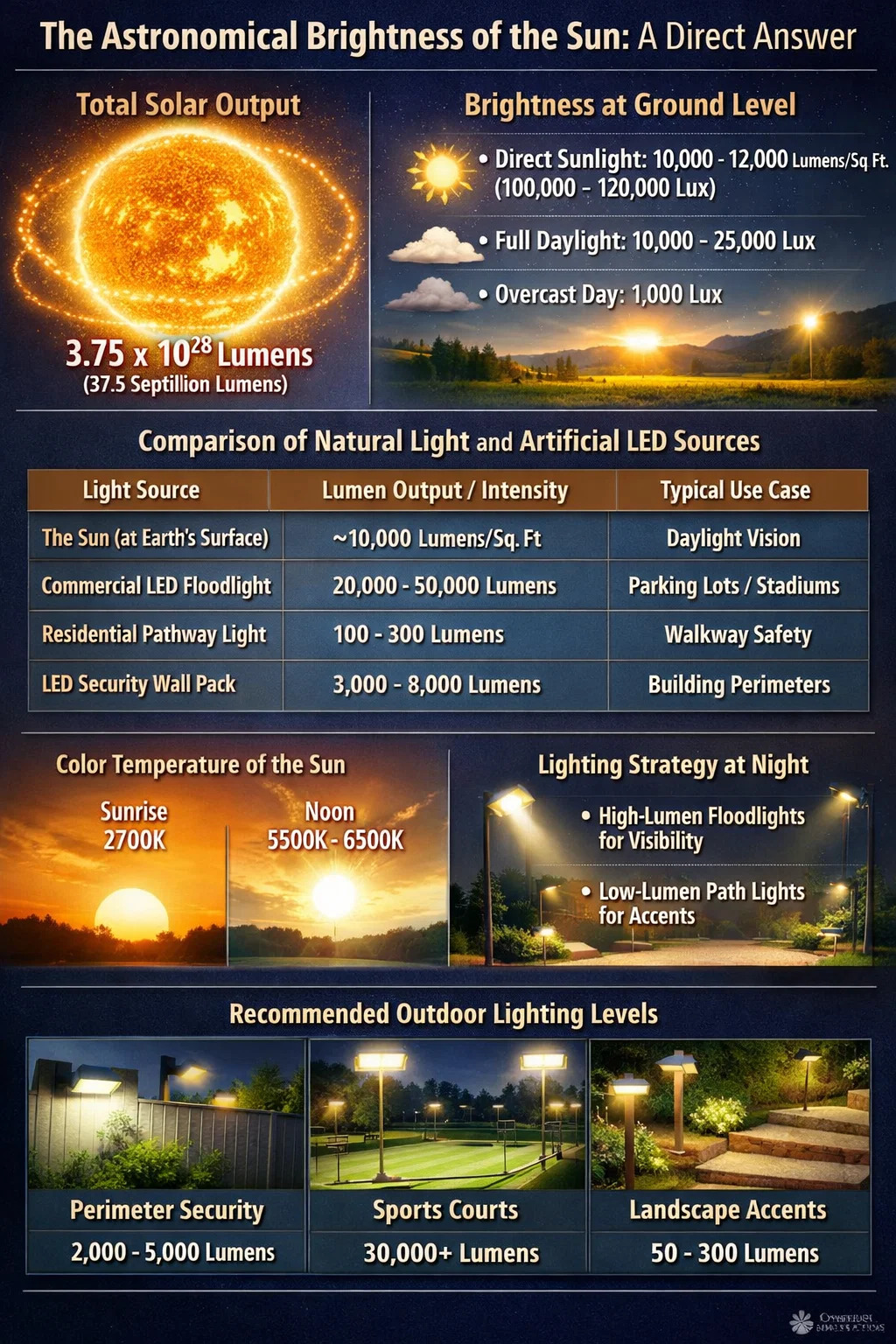
The total luminous flux of the sun is approximately 3.75 x 10^28 lumens. This represents the total light energy emitted by the sun in all directions. However, for practical applications in lighting design and human perception, we focus on the light that actually reaches the Earth's surface. On a clear day at noon, the sun provides an illuminance of roughly 10,000 to 12,000 lumens per square foot (approx. 100,000 to 120,000 lux).
Understanding these figures is vital when planning Outdoor LED Lighting installations. While we cannot replicate the sun's intensity, these benchmarks help engineers determine how much artificial light is necessary to achieve visibility, safety, and aesthetic appeal in nighttime environments.
To grasp how bright the sun is, it is necessary to distinguish between total output and surface brightness. The sun functions as an omnidirectional light source, but only a fraction of its power reaches our planet due to the vast distance and atmospheric interference.
If we were to surround the sun with a giant sphere at its surface, the sensor would register 37.5 septillion lumens. This number is so large it becomes difficult to use in standard electrical engineering contexts, yet it serves as the ultimate baseline for all light energy in our solar system.
Atmospheric conditions significantly dictate how many lumens actually strike a specific area of your outdoor property. For instance:
When designing commercial or residential landscapes, the "sun standard" is often used to calculate contrast ratios. High-quality Outdoor LED Lighting aims to provide sufficient visibility without the blinding intensity of solar glare. Below is a comparison of common outdoor light sources and their typical lumen ranges.
| Light Source | Lumen Output / Intensity | Typical Use Case |
|---|---|---|
| The Sun (at Earth's Surface) | ~10,000 Lumens/sq. ft | Daylight Vision |
| Commercial LED Floodlight | 20,000 - 50,000 Lumens | Parking Lots / Stadiums |
| Residential Pathway Light | 100 - 300 Lumens | Walkway Safety |
| LED Security Wall Pack | 3,000 - 8,000 Lumens | Building Perimeters |
The concept of solar lumens is not just a trivia point; it defines how our eyes adapt to light. This is known as "Photopic Vision" (daylight) and "Scotopic Vision" (low light). When selecting Outdoor LED Lighting, professionals must account for the following factors influenced by solar standards:
The sun's color temperature changes throughout the day, from roughly 2700K at sunrise to 5500K-6500K at high noon. To mimic natural daylight in outdoor settings, high-output LED fixtures often utilize 5000K modules, which provide a crisp, white light that improves alertness and security visibility.
The primary challenge of nighttime lighting is the lack of the sun's ambient fill. Without 10,000 lumens per square foot, we rely on "layers" of light. Using a combination of floodlights (high lumens) and accent lights (low lumens) ensures that the human eye can navigate transitions between dark and lit areas without temporary "blindness" caused by extreme contrast.
Unlike the sun, which has been consistent for billions of years, artificial Outdoor LED Lighting experiences lumen depreciation. This is why understanding initial vs. delivered lumens is critical for long-term project planning.
If you are attempting to light a space to feel "bright" without the overkill of solar-level intensity, follow these industry standards for lumen distribution:
By referencing the sun's massive output, we realize that our goal with Outdoor LED Lighting is not to compete with the day, but to strategically manage the night. Selecting the right lumen count ensures that your space is functional, safe, and energy-efficient.

Contact Us for More Details
Contact Information
Add:
No. 8 Qingcang Road, Qiangjiao Town, 315612 Ninghai, Ningbo, China
Phone:
+86-574-83530320
Fax:
+86-574-83530330
E-mail:
Join our community and stay connected
 Custom Outdoor lighting Manufacturers

 English
 Français
 Español