2026-02-23
Content
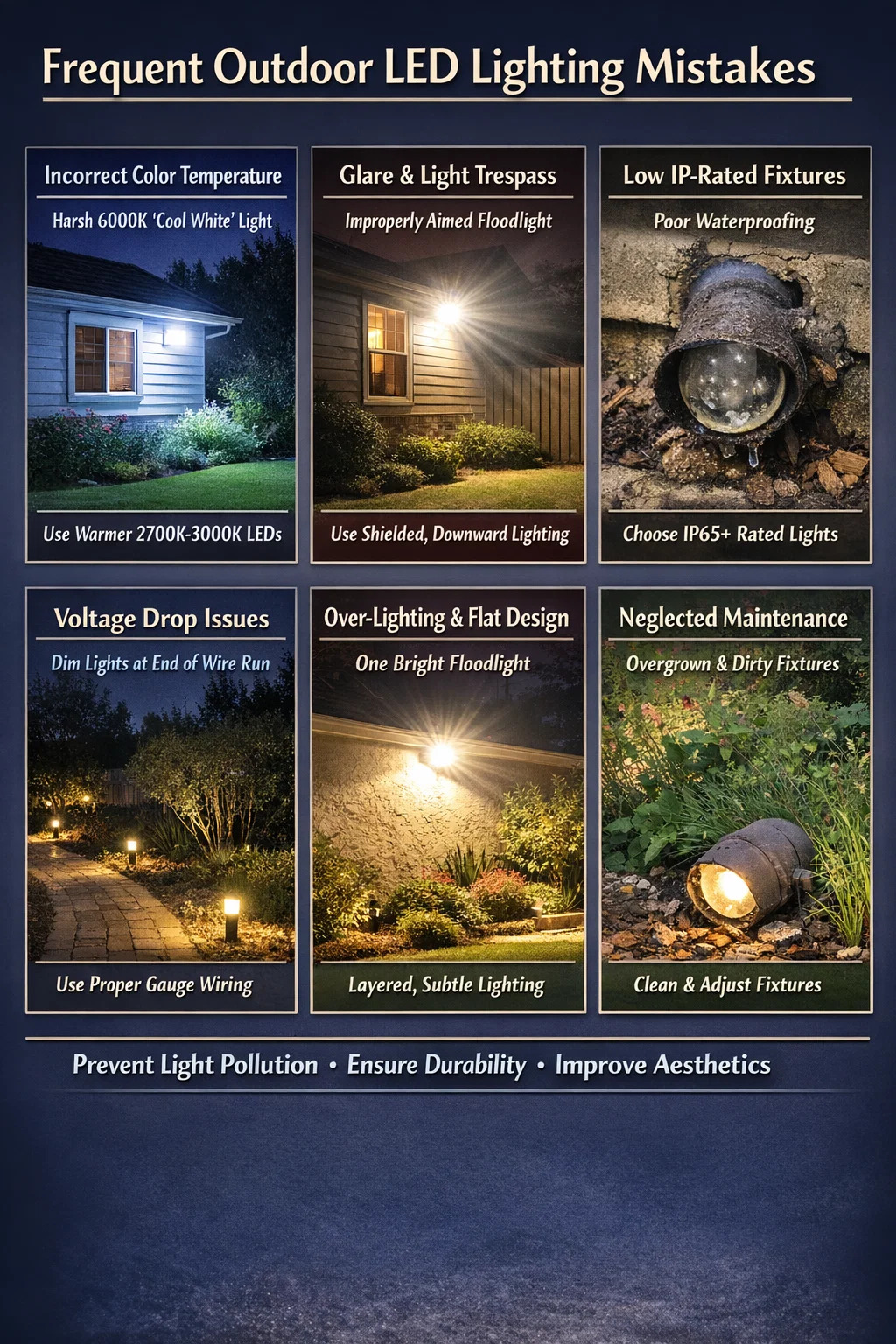
The most critical outdoor LED lighting mistakes involve excessive glare caused by improper fixture aiming, selecting the wrong color temperature (CCT), and neglecting the "Dark Sky" principles that prevent light pollution. Additionally, many property owners fail to account for voltage drop in low-voltage systems or purchase fixtures with inadequate Ingress Protection (IP) ratings, leading to premature hardware failure. Addressing these issues requires a balance between functional lumen output and mindful placement to ensure safety without compromising visual comfort.
Getty Images
Choosing a light color that clashes with the environment is a common pitfall in outdoor LED lighting. Color temperature is measured in Kelvins (K), and using the wrong range can make a space feel clinical or eerie.
Many people install "Cool White" bulbs (5000K-6000K) in residential gardens, thinking more blue light equals better visibility. However, high Kelvin lights can disrupt local wildlife and create a harsh, "parking lot" atmosphere in a cozy backyard. For most landscape applications, 2700K to 3000K is the industry standard for creating a warm, inviting glow that mimics traditional incandescent lighting.
Glare occurs when a light source is directly visible to the eye, causing discomfort and actually reducing visibility by constricting the pupils.
A common outdoor LED lighting error is pointing floodlights outward rather than downward. This creates light trespass—where your light spills into a neighbor's window—and contributes to sky glow. To fix this, use "full cutoff" fixtures or glare shields (cowls) that direct the light precisely where it is needed.
Outdoor environments are brutal on electronics. Using interior-grade or poorly sealed fixtures is a recipe for short-circuits.
| IP Rating | Protection Level | Best Use Case |
|---|---|---|
| IP44 | Splash proof | Under porch ceilings |
| IP65 | Water jet resistant | General garden use |
| IP67/68 | Submersible | Ponds and heavy runoff areas |
Choosing a fixture with only an IP44 rating for an exposed garden wall is a critical error. During a heavy storm, moisture will penetrate the housing, corroding the LED driver and shortening its 50,000-hour potential to just a few months.
A common misconception is that "brighter is better." Over-lighting a property creates a flat, washed-out look that lacks depth and character.
Successful outdoor LED lighting design uses layers:
By leaving some areas dark, you create contrast. High-quality designs often use lower wattage LEDs (3W to 5W) in multiple locations rather than one giant 50W floodlight. This creates a more professional and aesthetically pleasing result.
In low-voltage (12V or 24V) outdoor LED lighting systems, many installers overlook the phenomenon of voltage drop.
When a wire run is too long or the wire gauge is too thin, the lights at the end of the chain will appear dimmer than those near the transformer. For a 100-foot run, using 12-gauge wire is often necessary to maintain consistent brightness. Additionally, using standard wire nuts instead of waterproof grease-filled connectors will eventually lead to copper corrosion, causing the entire system to flicker or fail.
"Set it and forget it" is a myth. Even the best outdoor LED lighting requires occasional care.
A frequent mistake is not account for plant growth. A spotlight that highlights a sapling today will be buried in foliage three years from now. Furthermore, dirt and hard water deposits on the lenses can reduce light output by up to 20%. Regular cleaning and adjusting the position of fixtures as the landscape matures are essential steps that most users skip, leading to a degraded lighting effect over time.

Contact Us for More Details
Contact Information
Add:
No. 8 Qingcang Road, Qiangjiao Town, 315612 Ninghai, Ningbo, China
Phone:
+86-574-83530320
Fax:
+86-574-83530330
E-mail:
Join our community and stay connected
 Custom Outdoor lighting Manufacturers

 English
 Français
 Español