2026-03-02
Content
The short answer is no — LED lights do not cause a high electric bill. In fact, they are one of the most effective tools for reducing energy costs in both residential and commercial settings. LED bulbs consume up to 75% less energy than traditional incandescent bulbs and last 25 times longer, according to the U.S. Department of Energy. If your electric bill feels high, LEDs are almost certainly not the culprit. More likely, other high-draw appliances like HVAC systems, water heaters, or older refrigerators are responsible.
That said, how you use LEDs matters. Running a large number of outdoor LED lighting fixtures around the clock, without timers or motion sensors, can add up over time — not because LEDs are inefficient, but simply because of total operating hours. Understanding the numbers behind LED energy consumption helps you make smarter choices for your home or property.
To understand LED energy consumption, it helps to look at real wattage numbers and compare them directly to older lighting technologies. The electricity you pay for is measured in kilowatt-hours (kWh), and the formula is simple: watts × hours of use ÷ 1,000 = kWh consumed.
Here's a practical comparison:
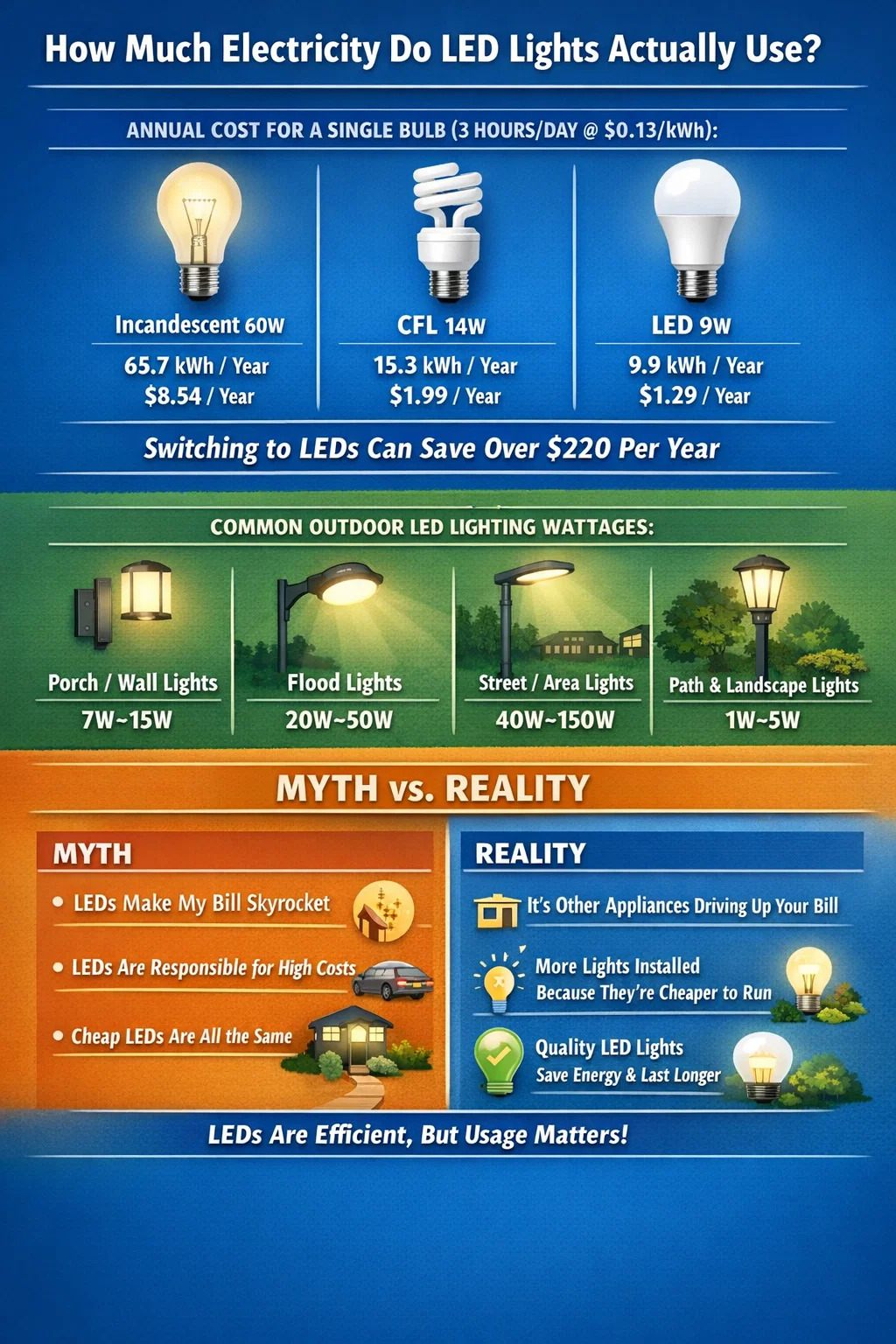
| Bulb Type | Wattage (equivalent 800 lumens) | kWh per Year (3 hrs/day) | Annual Cost (@ $0.13/kWh) |
|---|---|---|---|
| Incandescent | 60W | 65.7 kWh | ~$8.54 |
| CFL | 14W | 15.3 kWh | ~$1.99 |
| LED | 9W | 9.9 kWh | ~$1.29 |
The difference is stark. If a home has 30 light fixtures and switches entirely from incandescent to LED, the annual savings could exceed $220 per year from lighting alone. For commercial properties with hundreds of fixtures, those savings scale dramatically.
Outdoor LED lighting covers a wide range of applications — from simple porch lights to full-scale landscape lighting systems, parking lot floodlights, security lights, and pathway illumination. Each has a different wattage range and usage pattern, which directly affects energy costs.
A typical residential property running four 30W LED floodlights for 10 hours per night would consume 1.2 kWh per night, or about 36 kWh per month — adding roughly $4.68 to a monthly bill at average U.S. rates. That same setup using older 150W halogen floods would consume 180 kWh per month, costing around $23.40. The LED system saves over $220 per year on just four outdoor fixtures.
There's a persistent misconception that LED lights contribute significantly to high electricity bills. This usually comes from a few common misunderstandings or coincidental timing rather than actual data.
Behavioral economics researchers call it the "rebound effect" or "Jevons paradox": when energy becomes cheaper to use, people tend to use more of it. A homeowner who switches to LEDs might add more outdoor LED lighting fixtures, install accent lights, or leave lights on longer than before — simply because each hour of use costs so much less. The result can be a bill that stays flat or even rises slightly, even though the per-lumen cost dropped dramatically. The issue isn't the LEDs themselves — it's expanded usage.
People often switch to LEDs during home renovations or seasonal changes — the same periods when heating, cooling, or new appliances are introduced. A new HVAC system running heavily in summer, combined with a new LED lighting setup, might result in a higher overall bill than the previous winter. Without careful tracking, the LEDs get blamed for what the air conditioning actually drove.
Not all LED products are equal. Cheap, poorly manufactured LEDs may not deliver the rated lumens-per-watt efficiency advertised. Some budget LEDs draw more power than their label suggests, or degrade quickly and consume disproportionate power as they age. Choosing ENERGY STAR-certified outdoor LED lighting ensures you're getting verified performance numbers.
Taking control of your energy costs starts with knowing the exact numbers. Here's a straightforward method to calculate what your outdoor LED lighting setup costs per month:
Example: Five outdoor LED lights at 25W each, running 11 hours per night: 5 × 25W = 125W total → 125W × 11 hours = 1,375 watt-hours/day → 1.375 kWh/day → 41.25 kWh/month → at $0.15/kWh = $6.19/month. That's a negligible contribution to your bill.
Compare that same setup using old 150W halogen floodlights: 5 × 150W × 11 hours × 30 days ÷ 1,000 × $0.15 = $37.13/month. The LED upgrade saves over $370 per year on outdoor lighting alone.
Even though outdoor LED lighting is already efficient, there are several practical ways to reduce energy consumption further without sacrificing security, aesthetics, or functionality.
A 50W LED floodlight running all night for 30 days consumes about 18 kWh per month. The same light with a motion sensor that activates for a combined 2 hours per night uses only 3 kWh per month — a reduction of over 83%. Motion-activated outdoor LED lighting also enhances security by drawing immediate attention when something moves, rather than providing constant ambient light that occupants stop noticing.
Photocell (dusk-to-dawn) sensors turn lights on only when ambient light drops below a threshold, preventing fixtures from running during daylight hours if a timer is misconfigured. Smart outdoor LED lighting systems go further — you can set schedules, dim lights after midnight, and monitor real-time consumption from a smartphone app. Dimming outdoor fixtures by 50% after midnight, when foot traffic and visibility needs are lower, can cut those hours' energy use in half without any noticeable loss in performance.
Overlighting is a common and expensive mistake. A driveway that realistically needs 500 lumens of illumination doesn't benefit from a 3,000-lumen floodlight. Excess brightness creates glare, wastes energy, and contributes to light pollution. Matching the lumen output of your outdoor LED lighting fixtures to the actual coverage area and task reduces unnecessary wattage. Use an illumination calculator or consult a lighting designer to right-size every zone.
For pathway lights, accent fixtures, and low-intensity decorative outdoor LED lighting, solar-powered options eliminate grid consumption entirely. Modern solar LED path lights can deliver 6–8 hours of operation on a full charge, and premium models include dusk-to-dawn sensors and multi-mode brightness settings. The upfront cost is higher than wired fixtures, but the long-term operating cost is essentially zero.
Rather than running all outdoor LED lighting on a single circuit, divide your property into zones — front entry, backyard perimeter, driveway, garden accents — each with independent scheduling. A backyard zone might only need to run 2 hours after dinner, while a front entry light runs dusk-to-dawn for curb appeal. Zone-based control prevents unnecessary operation and allows granular energy management.
If you're paying a high electricity bill and recently switched to LEDs, it's worth investigating the real culprits. Here's where most residential electricity usage actually goes:
| Appliance/System | Share of Average Home's Energy Use | Typical Monthly Cost |
|---|---|---|
| Heating & Cooling (HVAC) | ~45% | $50–$150+ |
| Water Heater | ~18% | $20–$50 |
| Washer & Dryer | ~13% | $15–$40 |
| Refrigerator | ~4% | $5–$15 |
| Lighting (all LED) | ~5% | $5–$15 |
| Electronics & Standby | ~12% | $10–$30 |
Lighting — even pre-LED — represents a small fraction of total home energy consumption. With LEDs, that fraction shrinks further. If your bill is high, the answer is almost certainly your HVAC system, water heater, or electric dryer — not your outdoor LED lighting.
A few specific scenarios that can spike an electric bill unexpectedly:
When shopping for outdoor LED lighting, several specifications determine both performance and long-term energy costs. Understanding these helps you avoid products that underperform or consume more power than necessary.
Lumens measure light output; watts measure power draw. Lumens per watt (lm/W) is the efficiency rating that matters most. Entry-level LED fixtures deliver around 80–100 lm/W. High-quality outdoor LED lighting products from reputable brands often achieve 120–160 lm/W, which means significantly more light per watt of electricity consumed. Always compare this spec rather than just wattage alone.
Outdoor LED lighting must carry an appropriate Ingress Protection (IP) rating to withstand weather. IP65 means completely dust-tight and protected against water jets — suitable for most residential outdoor applications. IP67 or IP68 is required for submerged or flood-prone installations. Using an indoor-rated LED fixture outside will degrade rapidly, losing efficiency and eventually failing prematurely, which undermines your energy savings through increased replacement costs.
Color temperature (measured in Kelvin) doesn't directly affect energy consumption, but it influences perceived brightness and practical utility. For outdoor LED lighting in residential settings, 2700K–3000K (warm white) provides a welcoming ambiance for entryways and patios, while 4000K–5000K (cool white or daylight) offers better visibility for security lighting and driveways. Note that some municipalities have ordinances restricting the use of high-color-temperature outdoor LEDs to reduce sky glow — check local regulations before installing very cool-white fixtures.
ENERGY STAR-certified outdoor LED lighting products meet strict efficiency and longevity standards set by the U.S. Environmental Protection Agency. Certified fixtures are tested for light output maintenance over time — meaning they maintain at least 70% of initial lumens over 25,000 hours of use. This prevents the gradual energy waste that comes from degraded fixtures drawing full power to produce diminished light.
The financial case for outdoor LED lighting extends well beyond monthly electricity savings. Replacement frequency and maintenance labor are significant hidden costs in traditional lighting systems that LEDs virtually eliminate.
A typical incandescent bulb lasts around 1,000 hours. A halogen floodlight lasts 2,000–5,000 hours. A quality outdoor LED light fixture is rated for 25,000 to 50,000 hours — sometimes more. At 10 hours of operation per night, a 50,000-hour LED fixture would last approximately 13.7 years before needing replacement. Over that same period, you'd replace a 1,000-hour incandescent bulb 50 times.
For commercial properties or municipalities managing hundreds of outdoor LED lighting fixtures, this translates to massive reductions in maintenance crew time, lift equipment rentals for high fixtures, and parts inventory costs. Cities that have converted street lighting to outdoor LED have reported maintenance cost reductions of 50–75% alongside energy savings of 40–60%.
Energy savings translate directly into reduced carbon emissions. In the United States, the average electricity grid produces approximately 0.386 kg of CO₂ per kWh consumed (EPA eGRID 2022 national average). The energy savings from replacing a single 150W halogen floodlight with a 30W LED — assuming 10 hours/night operation — amounts to approximately 437 kWh saved per year, equivalent to keeping 168 kg of CO₂ out of the atmosphere annually.
Scaled across the U.S., the Department of Energy estimates that widespread LED adoption could save approximately 569 TWh of electricity annually by 2035 — equivalent to the output of over 92 average-sized power plants. Outdoor LED lighting upgrades, particularly in commercial, industrial, and municipal settings, contribute significantly to these projections.
Unlike older fluorescent lamps, most outdoor LED lighting fixtures contain no mercury or other hazardous materials, simplifying disposal and reducing environmental risk at end of life. The long lifespan also reduces manufacturing demand and the waste stream associated with frequent lamp replacements.
LED strip lights are among the most power-efficient decorative lighting options. A standard 5-meter roll typically draws 24W–72W depending on the density and type (single-color vs. RGB vs. high-output). Running a 50W LED strip for 6 hours per day costs approximately $1.17 per month at $0.13/kWh. Extended outdoor LED strip light installations on pergolas or along rooflines are very manageable from an energy standpoint.
It won't destroy your bill, but it does add unnecessary cost. A single 15W outdoor LED porch light running all night (10 hours) uses 0.15 kWh per night — about $0.02. But 10 such fixtures running all night every night amounts to $6/month. Over a year, that's $72 for lights that may not need to be on between, say, 2 AM and sunrise. Using timers or smart controls to shut off non-essential outdoor LED lighting in low-traffic hours is easy and worthwhile.
Yes, dimming LEDs reduces power consumption roughly proportionally to the dim level, though the relationship isn't perfectly linear at very low dim settings. Dimming a 20W LED outdoor fixture to 50% brightness reduces its draw to approximately 10–12W — providing real energy savings. This makes dimmable outdoor LED lighting fixtures paired with smart controls a compelling option for areas like outdoor dining spaces or walkways where full-brightness operation isn't always required.
Payback period depends on usage hours, local electricity rates, and the cost differential between LED and legacy fixtures. In most residential scenarios, switching from halogen or incandescent outdoor fixtures to LED pays back the hardware cost differential in 1–3 years through energy savings alone, and then continues saving money for a decade or more afterward. Commercial or industrial conversions with high operating hours often achieve payback in under 18 months.

Contact Us for More Details
Contact Information
Add:
No. 8 Qingcang Road, Qiangjiao Town, 315612 Ninghai, Ningbo, China
Phone:
+86-574-83530320
Fax:
+86-574-83530330
E-mail:
Join our community and stay connected
 Custom Outdoor lighting Manufacturers

 English
 Français
 Español