2026-03-09
Content
If you've been told that turning lights off and on repeatedly wastes more energy than leaving them on, that advice does not apply to LEDs. With LED technology, turning the light off whenever it isn't needed is always the cheaper option. Unlike fluorescent lights from decades past, LEDs use no surge of power at startup and suffer no meaningful wear from switching cycles. Every second an LED is off is a second you aren't paying for electricity.
This applies whether you're managing indoor fixtures or outdoor LED lighting for a porch, driveway, parking lot, or commercial facade. The math is straightforward: an LED that is off draws zero watts, and one that is on draws anywhere from 4 watts to 150 watts depending on the fixture. Over a month or a year, those watts add up to real dollars on your utility bill.
The rest of this article breaks down exactly how much money is at stake, explains the science behind why LEDs behave differently from older bulb types, and gives practical strategies for managing outdoor LED lighting more efficiently.
To understand the cost difference, you need to know how electricity billing works. Utilities charge by the kilowatt-hour (kWh). One kilowatt-hour equals 1,000 watts used for one hour. The average residential electricity rate in the United States is approximately $0.16 per kWh as of 2024, though rates vary significantly by state — from around $0.10 in Louisiana to over $0.30 in Hawaii and parts of California.
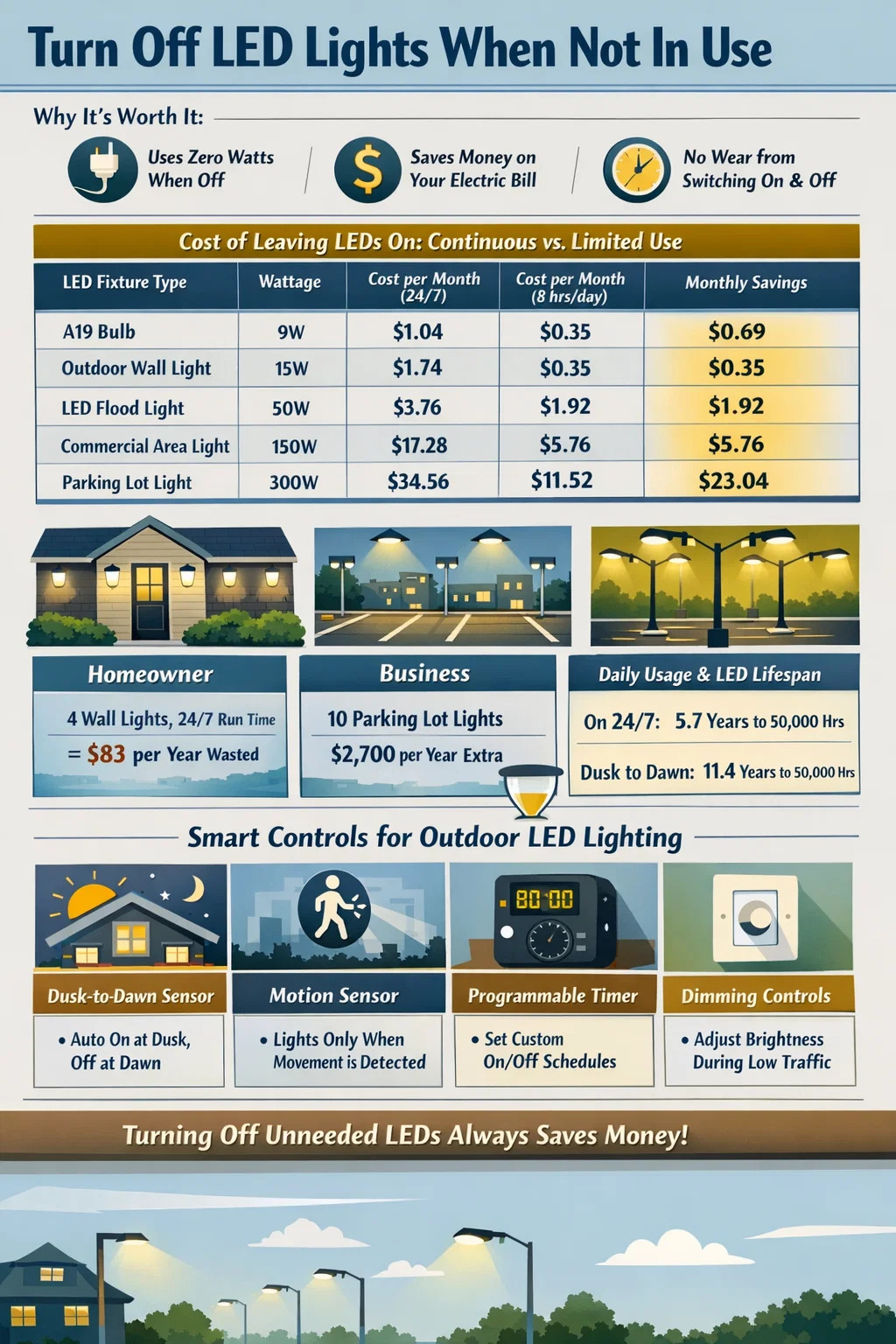
Here's a practical cost breakdown for common LED fixtures left on continuously versus being used only when needed:
| LED Fixture Type | Wattage | Cost per Month (24/7) | Cost per Month (8 hrs/day) | Monthly Savings |
|---|---|---|---|---|
| Standard A19 bulb | 9W | $1.04 | $0.35 | $0.69 |
| Outdoor wall light | 15W | $1.73 | $0.58 | $1.15 |
| Outdoor LED flood light | 50W | $5.76 | $1.92 | $3.84 |
| Commercial LED area light | 150W | $17.28 | $5.76 | $11.52 |
| LED parking lot light | 300W | $34.56 | $11.52 | $23.04 |
For a homeowner with four outdoor wall lights at 15W each running 24/7, that's nearly $83 per year in wasted electricity compared to running them only during dark hours. For a business operating a parking lot with ten 300W LED fixtures, the gap between running them all day versus only at night can exceed $2,700 per year.
The myth that you should leave lights on rather than switch them off repeatedly originated with fluorescent lighting. Fluorescent tubes and compact fluorescent lamps (CFLs) rely on a gas discharge process that requires a brief but real power surge to ignite the arc inside the tube. That startup also stresses the ballast and electrodes, shortening bulb life if done frequently. Studies in the 1990s found that turning a CFL on and off multiple times per day could reduce its rated lifespan significantly — sometimes cutting it in half.
LED technology operates on a completely different principle. LEDs — light-emitting diodes — produce light through electroluminescence. When current passes through a semiconductor material, electrons release energy in the form of photons. There is no filament to heat, no gas to ionize, and no arc to sustain. The result is a light source that:
The Department of Energy and major LED manufacturers including Cree, Philips, and Osram have all confirmed that switching LEDs on and off does not shorten their rated lifespan. A quality outdoor LED fixture rated for 50,000 hours will last those 50,000 hours regardless of how many times it's been cycled — whether that's 10 cycles or 100,000 cycles over its life.
The only nuance worth mentioning is that extremely rapid cycling — such as toggling a light dozens of times per second — can stress the driver circuitry in some low-quality LED products. But normal human-controlled switching, automated timer controls, or even motion sensor activations that might cycle a light 20 to 50 times per night have absolutely no detrimental effect on a well-engineered LED fixture.
Even if you do choose to leave lights on for extended periods — such as outdoor security lighting running through the night — LEDs are dramatically cheaper to operate than the technologies they replace. This context matters because many property owners upgraded from halogen, metal halide, or high-pressure sodium (HPS) fixtures to outdoor LED lighting and are now wondering how to manage them.
| Technology | Equivalent Output Wattage | Annual Cost (12 hrs/day) | Rated Lifespan (hours) |
|---|---|---|---|
| Incandescent | 60W | $41.86 | 1,000–2,000 |
| Halogen flood | 150W | $104.54 | 2,000–4,000 |
| Metal Halide | 400W | $278.78 | 6,000–15,000 |
| High-Pressure Sodium | 250W | $174.24 | 16,000–24,000 |
| Outdoor LED | 50W | $34.85 | 50,000–100,000 |
The efficiency gap is significant. A 50W LED flood produces the same amount of usable light as a 150W halogen fixture. Running the LED 24/7 for a full year costs less than running the halogen for 8 hours a day. Even an LED left on constantly is often cheaper than its predecessor running only part-time. That said, leaving even an energy-efficient LED on unnecessarily still wastes money relative to simply turning it off.
This is a legitimate concern separate from the switching question. While toggling LEDs on and off doesn't shorten lifespan, running them continuously does accumulate operating hours, and LEDs do eventually degrade. The industry standard for LED lifespan is L70 — the point at which lumen output has dropped to 70% of its original brightness. Most quality outdoor LED fixtures reach L70 after 50,000 to 100,000 hours of operation.
Here's how that translates into real-world years depending on usage pattern:
| Daily Usage | Hours per Year | Years to 50,000 hrs | Years to 100,000 hrs |
|---|---|---|---|
| 24 hours (always on) | 8,760 | 5.7 years | 11.4 years |
| 12 hours/day (dusk to dawn) | 4,380 | 11.4 years | 22.8 years |
| 8 hours/day | 2,920 | 17.1 years | 34.2 years |
| 4 hours/day | 1,460 | 34.2 years | 68.5 years |
An LED left on 24/7 will still last nearly 6 years before hitting the L70 threshold, and likely over a decade before actual failure. However, by reducing usage from continuous to 12 hours per day — the typical dusk-to-dawn cycle for outdoor LED lighting — you double its functional lifespan and cut your electricity cost in half simultaneously. That's a significant compounding benefit over time.
Heat is the primary enemy of LED longevity. LEDs degrade faster in high-temperature environments. Running them continuously generates more cumulative heat exposure than running them intermittently. Outdoor LED lighting fixtures in hot climates benefit especially from not being run during the hottest daylight hours.
The most effective approach to managing outdoor LED lighting costs isn't just choosing between "always on" and "always off" — it's implementing smart controls that match lighting output to actual need. This category of solutions has expanded dramatically in recent years, and even entry-level products offer meaningful energy savings.
Photocell sensors detect ambient light levels and automatically turn outdoor fixtures on at dusk and off at dawn. They're the simplest and most common control for residential and commercial outdoor LED lighting. A photocell costs $10–$30 and eliminates the risk of lights being left on during daylight hours — a surprisingly common source of wasted energy in both homes and commercial properties. The average home with three outdoor fixtures and no photocell burns an extra $50–$90 per year from daylight operation.
Motion-activated outdoor LED lighting turns on only when movement is detected, staying off during the quiet periods in between. For areas like driveways, side entrances, back yards, and pathways, motion sensing can reduce runtime by 60–85% compared to all-night operation. A 50W LED flood running all night (10 hours) uses 0.5 kWh per night, or about $29 per year. With a motion sensor reducing active time to 1.5 hours per night on average, that drops to $4.35 per year — a saving of $24.65 per fixture annually.
Digital timers allow you to set specific on/off windows for outdoor LED lighting. For a business that needs its parking lot lit from 6 PM to 11 PM but not all night, a timer eliminates the cost of those additional 7 overnight hours. On a 150W commercial area light, that's a saving of roughly $61 per fixture per year compared to running it all night. Timers cost $15–$60 and pay for themselves within weeks in high-wattage applications.
Many modern outdoor LED lighting systems support 0–10V dimming or DALI protocols, allowing brightness to be reduced during low-traffic periods rather than switching off entirely. A parking lot might run at full output (300W per fixture) from 7 PM to midnight, then dim to 30% output (90W) from midnight to 6 AM. This hybrid approach balances safety, security, and energy cost. At $0.16/kWh, dimming those 10 fixtures from 300W to 90W for 6 hours per night saves approximately $418 per year.
For commercial properties, municipalities, and industrial sites, networked LED control systems from companies like Acuity Brands, Lutron, or Enlighted offer centralized management of all outdoor LED lighting from a single interface. These systems can combine photocell input, motion detection, scheduling, dimming, and fault monitoring. Studies from the Lighting Research Center have found that networked controls can reduce outdoor lighting energy consumption by 50–75% compared to uncontrolled operation.
There are situations where leaving outdoor LED lighting on continuously — or for extended periods — is justified despite the energy cost. Understanding these scenarios helps you make a more informed decision rather than applying a blanket rule.
Continuous outdoor lighting deters trespassing and theft at commercial properties, warehouses, and storage facilities. Studies by the Lighting Research Center and the Urban Land Institute suggest that well-lit exterior environments reduce opportunistic crime. In this context, the cost of running a 50W LED all night — about $29 per year — is negligible compared to the liability or replacement cost of a single security incident. However, motion-activated lighting can provide the same deterrence at a fraction of the energy cost, since the sudden illumination of a motion sensor is actually more startling and attention-grabbing than constant light.
Steps, slopes, parking garage entrances, loading docks, and public pathways require consistent illumination for safety compliance and liability reasons. Many commercial and municipal codes mandate minimum maintained illuminance levels on these surfaces at all hours. In these cases, outdoor LED lighting must remain on, and the focus shifts to selecting the most efficient fixture and wattage rather than controlling hours of operation.
Landscape lighting, facade illumination, and signage lighting are often left on for aesthetic and brand reasons. A hotel or restaurant running LED architectural lighting at 200W total for 8 hours each evening spends about $93 per year on that display — usually considered a reasonable marketing and ambiance investment. These applications are better optimized by reducing wattage and selecting warm-white LEDs that create impact with fewer lumens than by reducing hours dramatically.
Some outdoor LED fixtures are mounted at heights or in locations where adding a control device is impractical or expensive. On a tall pole fixture or a remote barn light on a rural property, the cost of installing a networked control may exceed years of energy savings. In these cases, a simple photocell integrated into the fixture itself — available on most commercial outdoor LED lighting products — provides basic dusk-to-dawn control with no additional installation work.
You don't need complicated software to estimate how much you'd save by managing your outdoor LED lighting more efficiently. Here's a straightforward formula:
Example: A 100W outdoor LED area light currently running 18 hours per day (poorly managed timer).
Multiply that by 10 fixtures on a commercial property and you're looking at $467 per year from a simple timer adjustment — no hardware upgrades, no new fixtures, just better scheduling.
Beyond the on/off question, selecting the right outdoor LED lighting fixture in the first place has a large impact on long-term energy costs. Not all LEDs are equally efficient, and the efficiency differences between products can translate into hundreds of dollars in savings over the fixture's life.
Efficacy measures how much usable light a fixture produces per watt of electricity consumed. Entry-level outdoor LED lighting products typically achieve 80–100 lumens per watt. Mid-range commercial products reach 120–140 lm/W. High-performance fixtures from leading manufacturers now achieve 180–220 lm/W. Choosing a 180 lm/W fixture over an 80 lm/W fixture to achieve the same illuminance means using less than half the wattage — and less than half the electricity cost over the fixture's entire lifespan.
The DesignLights Consortium (DLC) Qualified Products List and ENERGY STAR certification both provide vetted benchmarks for commercial and residential outdoor LED lighting efficiency. DLC Premium-listed fixtures must meet minimum efficacy thresholds of 100–130 lm/W depending on fixture type. Selecting DLC-listed fixtures also qualifies for utility rebate programs in most states, which can offset 20–50% of the purchase cost upfront. Many utilities in California, New York, and the Pacific Northwest offer rebates of $30–$150 per fixture for qualifying outdoor LED replacements.
Choosing the right color temperature and optic distribution for outdoor LED lighting means you can achieve adequate visibility and safety with fewer total lumens — and therefore fewer watts. A well-directed 3000K warm-white LED with a targeted Type III or Type IV distribution pattern covers a parking lot or roadway more effectively than a poorly directed 5000K fixture producing more raw lumens but scattering them wastefully. Using the right fixture design for the application lets you downsize wattage without sacrificing performance.
When upgrading existing fixtures to outdoor LED lighting, you have two broad options: retrofit kits that replace the light source within an existing housing, or full fixture replacements with purpose-built LED optics and drivers. Retrofit kits are less expensive upfront but typically achieve lower efficacy than integrated LED fixtures designed from the ground up for LED technology. For long-term energy optimization, full fixture replacement generally delivers better return on investment — particularly for commercial and industrial applications where lights run thousands of hours per year.
Managing outdoor LED lighting efficiently doesn't require complex decisions. The core principles are consistent and supported by straightforward data:
Whether you're a homeowner with a few porch lights or a facility manager overseeing a large commercial property, the financial case for turning off outdoor LED lighting when it isn't needed is clear and consistent. The technology makes it easy, and the savings — while modest per fixture — accumulate meaningfully across a full property and over a full year.

Contact Us for More Details
Contact Information
Add:
No. 8 Qingcang Road, Qiangjiao Town, 315612 Ninghai, Ningbo, China
Phone:
+86-574-83530320
Fax:
+86-574-83530330
E-mail:
Join our community and stay connected
 Custom Outdoor lighting Manufacturers

 English
 Français
 Español